An authentick history of the late war between the united states and great britain by Paris M. Davis.
On the 7th July [1812] an order was issued from the Department of State of the United States requiring all British subjects to register their names, ages, places of residence, persons composing their families, &c. at the office of the Marshal of the United States, for the district in which such subjects resided.
British Aliens in the United States During the War of 1812 can be researched online at Ancestry.com.
Wednesday, February 29, 2012


Tuesday, February 28, 2012
Discordant, Disunited and Unprepared
"When war was declared, the country was discordant, disunited and unprepared."
Monday, February 27, 2012
Fort Gowris In Sandwich

Major [James] Denny with one hundred thirty convalescents and a corps of artillerists under Lieutenant Anderson was to hold possession of that part of Canada and afford all possible protection the well disposed inhabitants. A strong house belonging to one Gowris had stockaded and called Fort Gowris. In this and in a long stone building yet in Sandwich* which the American soldiers had used as barracks the convalescents were placed and Denny was ordered to defend the post... .
*This building was erected for a school in 1807 or 1808. It was in a dilapidated state when I sketched it in the autumn of 1860 It occupies an open space in the village of Sandwich. Several poor families occupied it. The place known as Spring Wells is opposite and indicated in our little sketch by the buildings with tall chimneys from which columns of smoke are rising. These compose the copper smelting works at Spring Wells.
From The pictorial field-book of the War of 1812; or, Illustrations, by pen and pencil, of the history, biography, scenery, relics, and traditions of the last war for American independence .
From Ohio History:
1812, Aug. 12. Major James Denny evacuates the fortification at Gowles on the Canadian shore; the last American force left in Canada. A boat with a flag of truce is sent from Detroit to Sandwich, the head- quarters of General Isaac Brock. Hull denies that he sent the flag. At this juncture the colonels of the Ohio Volunteers and General J. Taylor of Kentucky counsel together and suspect the abilities and fidelity of General Hull. A letter is sent to Gov. Return J. Meigs by Lewis Cass asking that reinforcements be sent, which letter is endorsed by the colonels and General Taylor.
Sunday, February 26, 2012
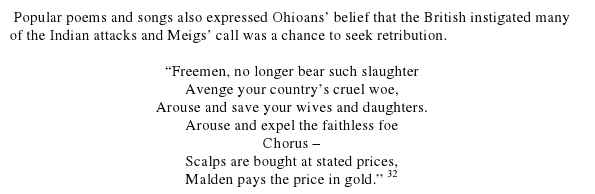
Ohioans' Belief About British Instigation In A Poem
Notes On The Ohio Militia during the War of 1812 by James T. Brenner, included a poem about British instigated attacks:

Lots of details about the status and organization of the Ohio militia, too.
Lots of details about the status and organization of the Ohio militia, too.
Tuesday, February 21, 2012
Who Wrote The Journal Of An American Prisoner?
At
Fort Malden and Quebec
in the
War of 1812
Although the author's name is not attached to the journal it bears unmistakable evidence of having been written by Surgeon's Mate James Reynolds who was deputed by Surgeon General Edwards of Gen. Hull's army to the charge of the sick on the two vessels that were dispatched from Maumee to Detroit, but which were captured at Fort Malden (Amherstburg) by the British. [Preface]
Didn't James Reynolds die on the same day as Hull's surrender? Is Surgeon's Mate James Reynolds a different person? The diary continued beyond the surrender date, so how was the diary written by Doctor James Reynolds from Zanesville, Ohio. Did one of his comrades use his diary after his death?
16th.—Sunday. Pleasant weather but unpleasant news we herd about noon that Hull had given up Detroit and the whole Territory Mitchigan. The Indians began to return about sunset well mounted and some with horses and chais. Who can express the feelings of a person who knows that Hull had men enough to have this place three times and[19] gave up his post. Shame to him, shame to his country, shame to the world. When Hull first came to Detroit the 4th U. S. Regt. would have taken Malden and he with his great generalship has lost about 200 men and his Territory.
Can he be forgiven when he had command of an army of about 2500 men besides the Regulars and Militia of his Territory and given up to about 400 regular troops and Militia and about 700 Indians.
17th.—Monday. Clouday. The news of yesterday was confirmed. The Indians were riding our horses and hollowing and shouting the whole day.
18th.—The Provo Marshal came on board and wanted a list of the Regular Troops, and told us that the Regular Troops were prisoners of war and the militia had liberty to go home. We were taken from the Schooner Thames and put into a little Schooner but every attention paid us that was possible. In the evening we were ordered on[20] board the Elinor. Their was a detachment of prisoners joined us.
19th.—Wensday. Pleasant. I got provisions and medicines on board. The other vessels came from Detroit. Nothing extraordinary through the day.
20th.—Thursday. Rainy. Unpleasant on board. The militia left the river.
21st.—Friday. We drifted out of the river into the Lake. Capt. Brown and Ensign Phillips came on board.
22nd.—Saterday. Clouday but no rain. We sailed to the Three Sisters and lay to for the Sharlott, and about 12 o'clock we came to ancor.
Sunday, February 19, 2012
Pre-War Treaty Violations In Michigan
At the conclusion of our war for independence, it was stipulated in the treaty that all frontier posts of the northwest then occupied by British garrisons were to be surrendered, but they were not. The Jay treaty followed and even that did not secure their evacuation until 1796.
Had the British remained tranquil, the occupation of those posts, though unlawful, had not materially injured the officers of the United States in arranging their Indian policy; but neither British officers nor traders remained tranquil.

Had the British remained tranquil, the occupation of those posts, though unlawful, had not materially injured the officers of the United States in arranging their Indian policy; but neither British officers nor traders remained tranquil.
See the excerpted selection below for more information:
Source: Transactions of the Illinois State.....
Saturday, February 18, 2012
Joseph Paxton's Early 1812 Experiences
The first part of Joseph Paxton's petition to Congress as written in the Congressional edition (Google eBook) (1841):
Joseph Paxton of Campbell County, Kentucky, volunteered his services as trumpeter in Captain F. Keiger's* rifle company of Louisville, Kentucky, and was at the battle of Tippecanoe in the year 1811. He fired the second gun and was the only musician who sounded a trumpet during that memorable engagement.
*Frederick Geiger
He again volunteered his services as trumpeter in Captain Johnson's troop of light dragoons which belonged to Colonel Simrall's regiment and was in the battle of the Mississinewa, under Colonel Campbell, in the year 1812 [and] again sounded the charge on the morning of the battle.
Joseph Paxton of Campbell County, Kentucky, volunteered his services as trumpeter in Captain F. Keiger's* rifle company of Louisville, Kentucky, and was at the battle of Tippecanoe in the year 1811. He fired the second gun and was the only musician who sounded a trumpet during that memorable engagement.
*Frederick Geiger
He again volunteered his services as trumpeter in Captain Johnson's troop of light dragoons which belonged to Colonel Simrall's regiment and was in the battle of the Mississinewa, under Colonel Campbell, in the year 1812 [and] again sounded the charge on the morning of the battle.
Subscribe to:
Posts (Atom)