Showing posts with label Pennsylvania. Show all posts

Friday, October 30, 2020

Lydia Bacon's Travel


Biography of Mrs. Lydia B. Bacon:

"...an account of her travels, and of the scenes through which she passed during the well-remembered war of 1812. This account, as she states, was made up from letters written at the time to her friends, and extracts from her journal, and commences with the date of her embarkation with the troops for Philadelphia en route for Pittsburgh, whither her husband, as Commissary, had preceded his regiment to prepare for its arrival."

Thursday, May 14, 2020

Charles J. Ingersoll, Historian


Charles Jared Ingersoll papers

Collection 1812

"Lawyer, politician, and author Charles Jared Ingersoll was born in Philadelphia on October 3, 1782 to Jared Ingersoll, a member of the 1787 Constitutional Convention and district judge, and Elizabeth Pellet."

"Over the course of his governmental career, Ingersoll worked with a few U. S. presidents such as James Monroe, John Tyler, and James K. Polk. In addition to his political career, Ingersoll worked as a lawyer in Philadelphia and was an accomplished writer. Beyond his early works, he published the two-volume History of the War of 1812-15 (1845, 1852)." [Source]


Sunday, March 15, 2020

Colonel Carr


The home journal., January 27, 1859, Image 2, (Winchester, Tenn.) 1858-188?:


Col. Robert Carr of Philadelphia, was Benjamin Franklin's errand boy and a colonel in the War of 1812.  
Source


Wednesday, November 6, 2019

Charles Stewart "Old Ironsides"


Source


" Old Ironsides" was saved, repaired, and converted into a school-ship. When the Naval Academy was temporarily removed from Annapolis to Newport, Rhode Island, on account of the Rebellion, the Constitution took her place at the latter station. Her latest commander in the war of 1812- 15, Rear Admiral Charles Stewart, yet [1867] survives, at the age of ninety-one years. He is sometimes called Old Ironsides. [Source - The pictorial field-book of the war of 1812...] 

Stewart's memorial at FindAGrave.

Sunday, July 7, 2019

Surgeon Sylvester Day


From the Manuscripts Division, William L. Clements Library at the University of Michigan, a finding aid for the Sylvester Day Collection, 1813-1920, Creator: Day, Sylvester, 1778-1851:

Biography
Sylvester Day was born in 1778, the son of Elkanah Day and Lavinia Merrill. He worked as garrison surgeon's mate in the United States Army in 1807, and was at Fort Michilimackinac from 1810 to July 17, 1812, when British forces took the fort during the War of 1812. After his parole by British forces, he travelled to Detroit, Michigan, where he worked as a surgeon until General William Hull surrendered the city to the British in August 1812. He remained in Detroit in order to help care for sick and wounded soldiers who were unable to leave with the rest of the American troops. On October 16, 1812, he left Detroit with American prisoners of war on the British Brig Adams, headed for Fort Erie. However, the United States Navy captured the Adams while en route to its destination, and forced Day to disembark before burning the ship and all of his personal effects. Following this incident, Day began a legal suit against the U.S. government in an attempt to gain reparations for the property he lost in the burning, especially his extensive medical library. The U.S. Army appointed Day a surgeon of the 4th Regiment of Infantry on March 13, 1813. He transferred to the 5th Infantry on May 17, 1815, and was on duty in Detroit, Michigan, until 1818. He worked as post surgeon at Fort Mifflin, Pennsylvania, from 1818 to 1820, and later became post surgeon for the Allegheny Arsenal. Day worked at other locations before his death at Allegheny Arsenal, Pennsylvania, in 1851.


Fort At Mackinac Island


226 Dr. Sylvester Day went to Michilimackinac as surgeon's mate at the garrison as early as 1810. He and his family resided on Astor Street at the time of the surrender of the fort. He had one son named Hannibal, who later became Gen. Hannibal Day. U. S. A. After leaving Michilimackinac they resided at Detroit. Dr. Day was a Mason and master of Zion Lodge, No. 62, in 1817. The same year he subscribed $350 toward the University Fund. {Michigan Pioneer Collections; Annals of Fort Mackinaw by Kelton, p. 46.)  [Source]


Friday, April 5, 2019

Major McFarland's Journal


From The Western Pennsylvania Historical Magazine... (article):

Major Daniel McFarland (1787 - 1814) of Washington County, Pennsylvania was in the 23rd U.S. Infantry...

Source

Also see Major McFarland's Papers blogpost


Wednesday, March 13, 2019

James Tilton


Source

"[James Tilton] had arrived at a time of life which would justly entitle him to retirement and rest from the onerous duties of a laborious profession when in 1812, 'war's loud alarms' again aroused his interest in military medicine...".

 "...his selection as...Surgeon General when that office was established by the army staff organization act of March 13, 1813."

"In this work he elaborated his objections to large and overcrowded general hospitals and accentuated the desirability of distributing the sick in small regimental hospitals"


Saturday, January 19, 2019

Lay In The Black Swamp


General Area Of The Black Swamp In Ohio (Source - LOC)

This rain in January, 1813, was very general, especially in the valley of the Mississippi, for our troops in the northwest under General Harrison at this time, lay in the Black Swamp, some twenty miles beyond Lower Sandusky, where, from the nature of the ground, it was with difficulty that the troops could find dry ground to stand on, much less to sleep on at night. The hardships endured by these men during that winter campaign were such as not only to try men's souls, but to try their mortal bodies also, for many of these brave men died on their way home, and many of them died a lingering death after they reached home, while many of them are still living, and have obtained a bounty land warrant, calling for eighty acres of land, which was obtained under a law passed September 28, 1850, and well they all deserved it, and much more had they got it. [Source]


Monday, December 31, 2018

Jacob Brown, The Fighting Quaker


Having secured his education and feeling himself able to establish a home of his own, Andrew Ellicott was married, December 31, 1775, at Newtown, in Bucks County, Pennsylvania, to Sarah Brown, whose father was a prominent " Friend," and a cousin of Jacob Brown, the "Fighting Quaker" of the War of 1812. [Source]


Source: JSTOR

Because Jacob Brown had married a non-Quaker and because he promoted a lottery, he was disowned 4th month 4, 1804.


Wednesday, September 26, 2018

Wednesday, June 13, 2018

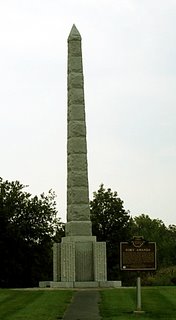
Fort Amanda


From The Ohio Country....(See e-mail information below)*

 The three thousand men then at Fort Barbee were at once started direct for Defiance, Harrison commanding in person. The first night they encamped at Fort Jennings, where word of the retreat of the enemy was received. This gave opportunity for part of the soldiers to clear the road to Defiance, and others to build a fortification farther up the Auglaize River, on the site of Wayne's Fort Auglaize. This post was named by Lieutenant-Colonel Pogue, its builder, Fort Amanda... .


Jim's Photo of The Fort Amanda Monument


*Note: I received the following information via email:

There are a couple items shown on the webpage regarding Fort Amanda that are incorrect. I’ve researched Fort Amanda for the past 43 years and just recently published my book titled; “Fort Amanda – a Historical Redress.” Fort Amanda was built by Lt. Col. Robert Pogue of the Kentucky militia, not Colonel Poague. Lt. Col. Pogue named the post for his 12 year old daughter Amanda. It was built in 2 phases, the first by Kentucky troops in Oct. 1812 then enlarged by Ohio militia troops in the spring of 1813. When finished there were 5 blockhouses, not 4.

See the Fort Amanda blog here (related to the above e-mail).


Friday, March 23, 2018

Falls Of Ohio


Falls of Ohio Mural


Letter written by Colonel Jonas Simonds of the 6th Infantry (23rd March 1811?) from his post at Fort Fayette:

Fold3

"...for better security of the transports under my command in descending the river--but I find no authorized pilot in that place or any authority for the employ of one.... ."  "...fully secure without employing a citizen pilot--except for the Falls of the Ohio."


Source


Saturday, October 7, 2017

The Pennsylvania Line


Title: Southwestern Pennsylvania in song and story: with notes and illustrations
Author: Cowan, Frank, 1844-1905
Collection: Historic Pittsburgh Text Collection


Sunday, October 1, 2017

Wednesday, September 20, 2017

Stone In The War


Stone In War Of 1812:


The Bulletin, vol. 15, no. 17
Historic Pittsburgh Text Collection


"His grandfather, Abraham Stone, fought in the revolutionary war, and carried a musket at Bunker Hill.  His grandfather died from a gunshot wound received in the war of 1812."


Delmar, Tioga, Pennsylvania, United States
Israel Stone M 48 Massachusetts
Amanda A Stone F 42 Pennsylvania
Adaline D Stone F 17 Massachusetts
Dwight F Stone M 13 Pennsylvania
O B Stone M 10 Pennsylvania
Eugene H Stone M 8 Pennsylvania
William A Stone M 4 Pennsylvania
Israel G Stone M 1 Pennsylvania


Wednesday, September 13, 2017

Fort Stoddert Mentioned


Letter postmarked from Sunbury, Pa., on September 13, 1811, that mentioned Fort Stoddert near Mobile Bay in Alabama (formerly Mississippi Territory):


Fold3 - Source

Plant In Southern Alabama

Saturday, August 5, 2017

Stephen Foster's Father


Biography, songs and musical compositions of Stephen C. Foster, Authors: Foster, Stephen Collins, 1826-1864, Foster, Morrison, 1823-1904:


"My father [William Barclay Foster] was a man of great public spirit and unbounded patriotism.  During the War of 1812 he was appointed Quartermaster and Commissary of the U.S. Army."


University of Pittsburgh Archives and Manuscript Collections:
Subseries 10. William B. Foster Papers, 1814-1955
Scope and Content Notes:
This subseries includes the business papers of Stephen Foster's father, William B. Foster, Sr. It consists of correspondence, papers related to court cases, the War of 1812, the establishment of Lawrenceville, and materials general by Morrison Foster related to his attempts to settle his father's estate.

Section: 1. War of 1812 Correspondence and Transactions
Scope and Content Notes:
This section contains the correspondence of William B. Foster during his years as a commissary agent for the U.S. Army during the War of 1812. Most of these papers deal with supply and military sustenance issues; occasionally a letter emerges that tells of William’s amicable relationship with several of these military officers.