Showing posts with label Fort Mackinac. Show all posts

Tuesday, May 5, 2020

Dr. Reynolds And Captain Hanks Were Killed By An Explosion


From The Napoleon-Series Organization website, The War of 1812 Magazine Issue 18, June 2012, Later Development at Historic 1812 Military Sites near Detroit, By M.B. Walsh:


"...Dr. Reynolds, who was so pleased with the American artillery attack on the British shore on
5 July, was himself killed by a ball fired by the “British dogs” on the morning of 16 August 1812."

"The fire from the battery on the Canada shore, kept up slowly since dawn, had become very vigorous. Up to this time no casualty had resulted from it within the fort. Now a ball came bounding over the fort wall, dealing death in its passage. A group standing at the door of one of the officers’ quarters were almost annihilated. Captain Hanks, of Mackinaw, Lieutenant Sibley, and Dr. Reynolds... ." (Source)

Pension application for Margaret (McNiff) Hanks, the widow of Porter Hanks:


"...her said husband was killed by the explosion of a bomb at the Fort of Detroit, on the 16? day of August A.D. 1812...".


Friday, August 16, 2019

Hull's Surrender


Source

"This demand was received by Hull about 10 o clock in the morning. At this time a court of inquiry was sitting to examine into the surrender at Mackinaw. Upon seeing the white flag, Colonel Miller adjourned the court and Captains Fuller and Snelling were sent to receive the flag, which was borne by Lieutenant McDonald and Captain Glegg."  Source and Source


Saturday, July 27, 2019

Letter Of The 27th


Cannon At Campbell's Island, Illinois


"The battle of Campbell's Island", July 19, 1814

Black Hawk's memory is at fault, he does not state exactly what these Indian messengers told him. Colonel McKay, whose army of British and Indians had attacked Prairie du Chien, in a letter to his superior officer, under date of July 27, 1814, says that on the seventeenth of July about three o'clock in the afternoon, after the gun boat "Governor Clark" had been driven from its position by the British cannon and had started down the river, that he immediately sent off a canoe with three men, an Iowan, who had come from Mackinac with him, and two of the six Sauks, who had joined him on the Fox river, that he gave them four kegs of gun powder and ordered them to pass the "Governor Clark" and get as soon as possible to the Rapids at the Rock river, where he believed the gun boat would run aground; that they should collect all the Sauks and annoy the "Governor Clark" and prevent their landing to get fire wood, etc.

Black Hawk collected his warriors and determined to attack the boats which had now started up the river, as Black Hawk says : "I collected my warriors and determined to pursue the boats, I immediately started with my party by land, in pursuit, thinking that some of their boats might get aground, or that the GREAT SPIRIT would put them in our power, if he wished them taken."


Monday, July 17, 2017

Fencibles At Prairie du Chien Surrender


Source


"Early in June an American force took possession of the Indian post at Prairie du Chien, on the Mississippi, almost 500 miles from Mackinac, and Col. M'Douall, who was now in command at the latter place, resolved to dislodge them. Accordingly, Colonel M'Kay, of the Michigan Fencibles, was sent to Prairie du Chien with a detachment consisting of his own corps and of Canadian Volunteers, 150 men in all, with a 3 pounder. He also was accompanied by about 500 Indians."

"The detachment reached its destination on the 17th July and found that the Americans had erected a small fort... ."

""...M'Kay advanced his men against the fort, upon which a white flag was immediately displayed and the place surrendered with its garrison of 65 men and its cannon and stores. Not one man of M'Kay's white troops was even wounded in this brilliant affair...". [Source]


Sunday, July 17, 2016

Immediate Surrender


Rock Formation On Mackinac Island


Source


17th July, 1812.
Capitulation agreed upon between Captain Charles Roberts, commanding His Britannic Majesty's forces on the one part, and Lieutenant Hanks, commanding the forces of the United States of America, on the other.


Fort Mackinac


Thursday, September 3, 2015

Violations Of The Treaty Of Paris


Fort At Michilimackinac

"By the Treaty of Paris, in 1783, Great Britain recognized the independence of her American colonies. But she gave them up reluctantly, and soon proved that she would yield no more than she was compelled to. In violation of the terms of the treaty she kept garrisons for a dozen years at several western outposts--notably Niagara, Detroit, and Michilimackinac--and incited the Indians to harass the settlers who were crossing the Alleghenies. (The Americans were far from blameless. We had refused to pay debts owed to British merchants or to compensate Loyalists for the loss of their property. We had agreed to do both.)." [Source?]


Friday, July 24, 2015

A Chief Of The Ottaway


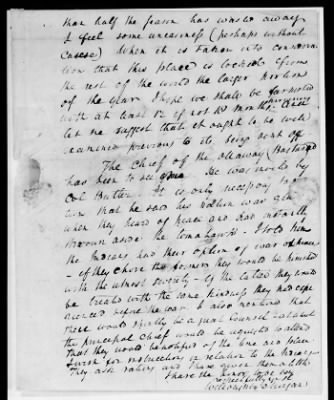
Last page of a letter written by Major Willoughby Morgan; mentioned a Chief of the Ottaway who was invited by Col. Butler:

Source: Fold3


Thursday, April 30, 2015

Degredation Inflicted By Armstrong


Source

The Life of Major-General William H. Harrison... ...:

General Armstrong's plan of the campaign submitted to the President on the 30th of April, 1814, left no doubt that General Harrison would not be assigned a command in the active operations of the year.

But the Secretary of War [Armstrong] was not content with the degredation he had inflicted upon the brave Harrison in withdrawing him from his command and withholding him from active service during the approaching campaign. 

He still persisted in interfering with his prerogatives as the commander of the district. His next unworthy act was to dispatch to Major Holmes, a subordinate officer at Detroit, an order to take two hundred men from that port and proceed on board of Commodore Sinclair's fleet destined for Mackinac. This proceeding on the part of the Secretary of War was a gross invasion of military propriety as well as a direct insult to General Harrison, whatever may have been the design.


Tuesday, March 10, 2015

After Running The Gauntlet


Reconstruction of the fort on Mackinac Island


Heroes and Heroines of the Fort Dearborn Massacre: A Romantic and Tragic ... By Noah Simmons, included the following, about Mrs. Susan Simmons:


Sometime in the fall of I812 the warriors of Green Bay with their prisoners left Green Bay and marched to the ruins of Fort Dearborn, thence around the end of lake Michigan and up to Mackinac, which was still in the hands of the British and Indians. It was winter when they reached Mackinac, and negotiations for the ransom of the prisoners were opened. Mrs Simmons and her babe had suffered terribly while on the journey to Mackinac. Winter had come on and found her thinly clad while she was often compelled to seek food from under the snow. Still amid all her privations and hardships the heroic woman thought only of the safety and comfort of her child. While in Green Bay the Indians had, by various devices, attempted to take her babe from her, under the pretext of friendship.


Friday, December 19, 2014

A Road On Mackinac Island


Mackinac Island Rock Formation (A Road Below)


From Annals of Fort Mackinac:


"This road passing through the cemeteries [on Mackinac Island] leads in nearly a direct line through Early's (formerly Dousman's) farm to "British Landing."


Tuesday, July 22, 2014

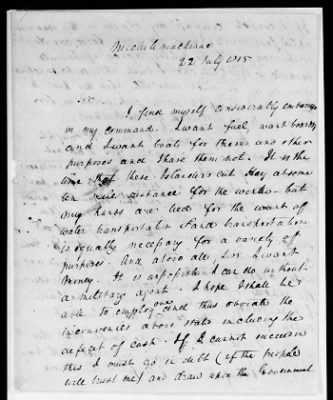
22 July 1815


From Letters Received By The Office Of The Adjutant General, 1805-1821, a document in the Willoughby Morgan file:

Postmarked Michilimackinac


"I find myself considerably embarrassed in my command.  ...It is the time that these Islanders cut hay at some ten miles distance for the winter--but my hands are tied for the want of water transportation... .  And above all...I want money.  It is unpossible [sic]...do without a military agent."


Tuesday, April 1, 2014

John Baker Wounded At Mackinac


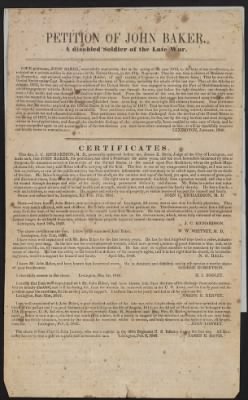
While a resident of Madison County, Kentucky, John Baker enlisted April 1, 1812, served as a private in Captain Caleb Holder's Company, 17th Regiment United States Infantry, and in Brevet Major John T. Chunn's Company, 3d Regiment United States Infantry, was at the battle of Fort Michilimackinac, where he received three wounds, one in the right arm, one in the neck and one through the skull, in the front of his head, and was discharged April 1, 1817.

Source - National Archives Via Fold3

PETITION OF JOHN BAKER
A disabled soldier of the Late War

Source - Fold3


From this site:

"Meanwhile, on 3 July, Lieutenant Colonel George Croghan sailed from Detroit to Michilimackinac. Three companies of the 17th Infantry participated in the unsuccessful attack on Fort Mackinaw on 4 August 1814 as did a detachment from the 19th Regiment."


Friday, August 23, 2013

Native American And British Influence At The Close Of The Revolutionary War

From History of the Late War in the Western Country:

At the close of the American revolution, many persons in England entertained an opinion that the American colonies were not irretrievably lost to the mother country. They hoped that Great Britain would be able, at some favor able moment, to regain the sovereignty of these States; and in this hope it is highly probable the British ministry participated. 

From calculations and sentiments like these, as well as from the irritation caused by the failure of their arms,
may have proceeded their unjustifiable conduct on the interior frontiers of the new States. The military posts of Niagara, Detroit, and Mackinaw were detained under various pretences, for many years, in violation of the treaty of peace.


The Indian tribes on our borders were at the same time supplied with munitions of war, and instigated to commit depredations and hostilities on the frontiers of Kentucky, and the settlements northwest of the Ohio.

Although this interference with the Indians was not an obvious and ostensible cause of the war, yet it may fairly be considered as a very efficient cause. Much of that resentment against the British, which prevailed so strongly in the western States, the principal advocates for the war, may fairly be attributed to this source.


Tuesday, August 20, 2013

Daniel Dobbins, Great Lakes Mariner


Per Wikipedia:  Daniel Dobbins (1776 - 1856) was "a sailing master in the United States Navy and captain in the United States Revenue Cutter Service. He fought in the War of 1812 and was in charge of the building of the ships* at Erie, Pennsylvania...".   *Building The Fleet In The Wilderness


Jim's Photo Of Mackinac Island In The Distance

Captain Dobbins was at Mackinac Island on board his vessel, the Salina, July 16, 1812, when he learned that war had been declared.  He was made a prisoner of war the same day by the British forces there. With sixty other Americans Captain Dobbins was asked to take the oath of allegiance to the British government and swear not to take up arms against Britain. This Dobbins refused to do. Among the British officials there was a petty officer by the name of Wilmoth, who knew Dobbins, with the result that he was allowed to depart with his vessel as a cartel, to take his fellow prisoners to Malden. [Source]

Source

The Buffalo [New York] History Museum has the Daniel Dobbins Collected papers.


See the US Brig Niagara sailing past Dobbins Landing in Erie, PA, on YouTube and an historical profile of Captain Daniel Dobbins here on YouTube.

A biography of Captain Dobbins can be found here, in the Encyclopedia of the War of 1812.


Saturday, May 18, 2013

Tuesday, March 26, 2013

Fort Holmes

This Fort was built while the British held possession of the Island in 1812 and 1814.  It was called by the British Fort George; in honor of the British king, afterward rechristened by the Americans in honor of Maj. Andrew Hunter Holmes, who was killed August 4, 1814, during an unsuccessful attempt by the Americans to regain possession of Fort Mackinac.  [Annals of Fort Mackinac]


Monday, March 25, 2013

Saturday, January 5, 2013

Adventures Of The Nancy - Part Two

See Part One


Tall Ship Replica On Lake Huron - NOT Nancy

From AN EPISODE OF THE WAR OF 1812. THE STORY OF THE SCHOONER "NANCY."

The next recorded incident in her history is narrated in a letter from her commander, Captain Alexander Mcintosh, to Captain Richard Bullock of the 41st Regiment, commanding the garrison at Mackinac, dated "5 miles from St. Joseph's," on the 16th of October, 1813. On the 4th of that month he had sailed from St. Joseph's for Amherstburg to obtain a much needed supply of provisions, and arrived at the mouth of the St. Clair river on the following afternoon when he sent two men ashore to ascertain whether it would be safe for him to enter the river. As they were prevented from returning by rough water, he decided to venture as far as the foot of the rapids. There he learned that the whole of the British squadron on Lake Erie had been taken and that the Americans were in possession of Detroit and Amherstburg. It was also reported that two of their armed schooners and two gun-boats were awaiting his appearance in the river below.


"Next day about noon," Captain Mcintosh wrote, "a white nag was seen coming towards us in a canoe. About half an hour afterwards I was hailed from the shore by a Canadian, ordering me to give up the vessel and that my property, as also that of the crew, should be respected. I went ashore to see who this man was. It was Lieutenant-Colonel Beaubien, of the militia, who wished me to surrender the vessel to him, repeating what he had already said. I told him I would give an answer in an hour's time.

I immediately went back and got all ready to defend the vessel. After the time had elapsed I went to him, gave him my answer, which was that I would defend the vessel until necessity compelled me to give her up, and that if the wind proved strong enough, I would attempt going back to the lake. He then replied, 'We shall fire on you.' 1 asked what number of men he had. 'Fifty,' was his answer. I returned to the vessel, made sail and was fishing the anchor when they commenced firing. I returned the fire as quickly as I received it, which continued for a quarter of an hour or more. They then ceased, whether from want of ammunition or that we had killed any, I know not.

During the action I was placed at the helm and exposed to the whole of their fire, but luckily escaped. Several shots struck the main boom and railing. No person was injured from their fire, but the blowing up of a couple of cartridges burnt one of the men severely on the face and hands. Whether it was from a piece of the cartridge or their lire, our main sail was blazing which was no sooner seen than extinguished. During the engagement my men behaved with the greatest coolness, and I cannot say too much for them.

As early as the 3rd of October, Captain Bullock had received information of the disastrous result of the battle on Lake Erie from Major-General Proctor, who informed him that he had already recommended that supplies for his garrison should be forwarded from York to Matchedash Bay.

The Nancy arrived on the 18th with her sails and cables so badly damaged as to render her unfit to navigate the lake during the storm of autumn, and Captain Mcintosh determined to take her to the Northwest Company's post, at Sault Ste. Marie, in the hope of procuring the necessary materials to refit her during the winter.

Here's a nice blog post about the Nancy and another from the Friends of Nancy Island and Wasaga Beach Park here.
Incorporating some archaeological aspects of the Nancy is a paper entitled "His Majesty's Hired Transport Schooner Nancy."

Thursday, October 25, 2012

No Mac Attack


A view of Mackinac Island from the Lower Peninsula

From Historic Mackinac:...:
Lieutenant [Porter] Hanks' report was not made until August 4, and is dated from Detroit.  He says that the reports of an interpreter and the coolness of the Indians in the neighbourhood first led him to think something was wrong, whereupon he sent Captain Dousman to watch them.  In part, the report which was made to General Hull reads: "On the 16th, I was informed by the Indian interpreter that he had discovered from an Indian that the several nations of Indians then at St. Joseph (a British garrison, distant about forty miles) intended to make an immediate attack on Michilimackinac.