 |
| Source |
Showing posts with label General Proctor. Show all posts
Showing posts with label General Proctor. Show all posts
Thursday, February 20, 2020


Friday, March 8, 2019
Residual Bad Feelings

The war of 1812 was due in great part to the bad feeling that had remained in the South and Wesit, particularly Kentucky, since the Indian wars. This feeling was intensified by the massacre of Frenchtown, or Raisin River, in January, 1813, when several hundred Kentuckian prisoners were killed by the Indian allies of General Proctor. [Source]
Wednesday, November 18, 2015
An Eyewitness At Old Fort Miami
| Source [War of 1812 Participant, Not Necessarily At Fort Miami] |
"In all this however there must be made an exception against the honor of the infamous Proctor*, the commander of the allied forces of the enemy. When the prisoners who had been taken from Colonel Dudley's command were taken to the British camp, below the fort, they were put into old Fort Miami, near by, and, in the language of an eyewitness, "the Indians were permitted to garnish the surrounding rampart, and to amuse themselves by loading and firing at the crowd, or at any particular individual. Those who preferred to inflict a still more cruel and savage death, selected their victims, led them to the gateway, and there, under the eye of General Proctor, and in the presence of the whole British army, tomahawked and scalped them." [Source]
*Update: It was noted in the comments section of the blog that the name is Procter, not Proctor. The source of the text spelled the name as Proctor, so I will leave it as is (with the added quotation marks that I should have originally included).
Monday, May 25, 2015

Monday, April 6, 2015
Thursday, March 19, 2015
Woodward And Proctor

The War of 1812 Magazine article, Remember the Raisin! Anatomy of a Demon Myth, By Sandy Antal:
"Unlike Canadians who usually explain away a complicated series of events through the alleged incompetence of the British commander, Americans have persistently demonized Colonel (later Major-General) Henry Procter as a bloodthirsty commander who either directed or permitted the murder of defenceless American prisoners. It was these alleged atrocities that gave rise to the slogan, Remember the Raisin!"
"Judge Woodward of Detroit...approached Colonel Procter on the subject, expressing outrage over the murders and depredations."
Friday, January 30, 2015
Officers Engaged In The Action
British participants In the Battle Of River Raisin:
| Source |
(1) Robert Richardson, Garrison Mate:
John Richardson was named as a volunteer from the 41st Regiment.
Monday, December 22, 2014
Colonel Proctor's Brilliant Successes

Colonel [Henry] Proctor, whom he [Sir Isaac Brock] left in command in Michigan, had a brilliant series of successes in the winter of 1812-13. He also received the surrender of two American generals and their armies---Clay, in Ohio; Wilkinson, at the River Raisin. Gen. Wilkinson and his army were brought down to Newark. Gen. Clay and his force were paroled and allowed to return home. [Source]
Tuesday, August 5, 2014
Blocking A Convoy

The situation at Brownstown from the Canadian/British point of view (taken from the Richardson War of 1812 book):
On the 6th of August [should be 5th August], information having been conveyed to Colonel Procter, that a body of the enemy were then on their march to convoy a quantity of provisions for the use of the garrison of Detroit, Brevet-Major Muir, with a detachment of about a hundred men of the forty-first regiment, and a few militia, received orders to cross the river and occupy Brownstown, a small village on the American shore, through which they were expected to pass; and thither we repaired accordingly.
Tuesday, May 27, 2014
Massacre Of Prisoners At Fort Miami?
 |
| Incident Near Site #3 |
On the surrender of Dudley's command the prisoners were marched down to Fort Miami with an escort, and there, under the eye of Proctor and his officers, the Indians, who had already plundered them and murdered many on the way, were allowed to shoot, tomahawk, and scalp more than twenty of them. This butchery was stopped by Tecumtha [Tecumseh], who proved himself to be more humane than his British ally and brother officer, Henry Proctor. [Source]
Wednesday, May 7, 2014
LeBreton At Fort Meigs
 |
| Fort Meigs |
In the following Spring he took an active part in a battle with the Americans on the Miami, being mentioned in General Proctor's dispatch in these terms:
' ' Lieut. LeBreton of the R.N.F.L. Regiment, Assistant Engineer by his unwearied exertions rendered essential service".
And later in the same dispatch General Proctor wrote--"I have to notice Captain Chambers' gallant conduct in the attack near the batteries at the point of the bayonet, a service in which he was well supported by Lt. LeBreton of the R.N.F. Land Regiment". [Source]
Thursday, May 1, 2014
LeBreton On The Miami

From Robert Randall and the Le Breton flats.... :
In the following Spring he [John LeBreton] took an active part in a battle with the Americans on the Miami, being mentioned in General Proctor's dispatch in these terms:
"Lieut. LeBreton of the R.N.F.L. Regiment, Assistant Engineer, by his unwearied exertions rendered essential service".
And later in the same dispatch General Proctor wrote--"I have to notice Captain Chambers' gallant conduct in the attack near the batteries at the point of the bayonet, a service in which he was well supported by Lt. LeBreton of the R.N.F. Land Regiment".
Wednesday, April 2, 2014
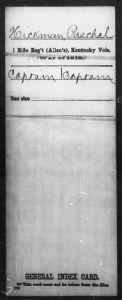
Captain Paschal Hickman
The Register of the Kentucky State Historical Society, Volume 7 (Google eBook)
Captain Hickman was severely wounded and was carried from the battlefield, both of his legs were shot off, or were so badly mangled that they were amputated the next morning, January 23, 1813.
 |
| Source |
Monday, January 6, 2014
Detroit Residents' Letter To Judge Woodward
After General Hull surrendered Detroit the previous August, frightened Detroiters sent a letter to [American] Judge Augustus Woodward (excerpt below), who was planning to leave, asking him not to abandon them. They had reason to be afraid; the letter was sent just prior to the nearby Battle of the River Raisin:
 |
| Source |
It was a matter of quite as great importance that the civil affairs of the community should be attended to as that the military affairs should be properly conducted. ...Woodward alone, remained in Detroit as the representative of the territory. [British] General Proctor, as civil governor under the terms of the capitulation, ordered the supreme court to convene at the council house in Detroit early in February 1813 and Woodward, as the only remaining judge, was expected to preside. Judge Woodward did not get along with General Proctor and did not think he could be an effective advocate for the citizens of Detroit because of it. [Source]
Saturday, November 16, 2013
Mahlon Burwell, His Capture And His Map
The colonization survey of the Talbot Road was made by Mahlon Burwell, a resident of Dunwich, who lived...near the home of Col. Thos. Talbot. Burwell surveyed from the Niagara to the Detroit.
He made a map and plan of Malden in time to give Gen. Proctor when on his way to Ft. Malden during that war. Letters to surveyors, Generals and other officials show he was at Niagara 1812-1813. In 1814 a small body of American soldiers ravaged the Pt. Talbot settlement, and Mahlon Burwell was carried off a prisoner. [Source]
See more about Mahlon Burwell's capture at the Elgin Historical Society's website.
Tuesday, October 1, 2013
Proctor Deserted After Perry's Victory
From The naval war of 1812: or the history of the United States Navy during the ... By Theodore Roosevelt:
 |
| Source |
"Some four thousand Indians joined Proctor, but most of them left him after Perry's victory on Lake Erie."
Monday, September 23, 2013
Michigan Territory In Canadian Hands
 |
| Michigan Territory Was Larger Than The Current State of Michigan |
Journal of Events....principally on the Detroit and Niagara frontiers...by Captain W. H. Merritt... .
"The Michigan Territory was in our hands. A great number of the Western Indians had reinforced Col. Proctor who was secure from any attack at that time."
Sunday, August 18, 2013
Mrs. Dodemead's British Piece
Soon after the surrender of 1812, British officers were sent round to disarm the citizens. One of them came to the door of Mrs Dodemead [in Detroit], who had in her care a little, old, dried-up, bedridden woman from Canada, whom she had kindly provided with a home. "Madam," said the officer, as Mrs. Dodemead opened the door, "I am ordered by Colonel Proctor to disarm the citizens, and take all guns to the fort. Have you any in your house?"
Mrs. Dodemead replied that she had "one British piece." "Follow me," she said, and leading the officer up stairs, she threw open a bedroom door, and pointing to the old lady said, "There, sir, is a British piece, all that I have. Seize her!" The officer turned on his heel, made a spring, hit the top, the middle, and the lower stair in his flight, and never called on Mrs. Dodemead again. [Source]
Mrs. Dodemead replied that she had "one British piece." "Follow me," she said, and leading the officer up stairs, she threw open a bedroom door, and pointing to the old lady said, "There, sir, is a British piece, all that I have. Seize her!" The officer turned on his heel, made a spring, hit the top, the middle, and the lower stair in his flight, and never called on Mrs. Dodemead again. [Source]
Thursday, April 11, 2013
Portrait Of George Croghan
| Source |
The Manuscripts Division, William L. Clements Library, University of Michigan, houses the Croghan family papers, including those of George Croghan:
Finding aid for Croghan Family Papers, 1794-1855
George Croghan joined the U.S. Army in 1812 and was quickly promoted to major. In 1813, at the age of 21, Croghan gained national acclaim from his successful defense of Fort Stephenson in northeastern Ohio, when he repelled a large British force lead by General Proctor.
Sunday, March 31, 2013


Subscribe to:
Posts (Atom)