Friday, March 7, 2014

Colonel McDougal And His Uniform


"British Uniform Coatee Worn by Colonel Daniel McDougal when he was an Ensign at the Battle of Lundy’s Lane on July 25, 1814 (see below)."

Source

"McDougal was born in...Scotland in 1782 and came to Canada with his parents who settled in Glengarry County. When the war broke out in June 1812, he was in the Glengarry Militia...".


Is this the same Daniel McDougal who is in an In Deeds post?


Records of the Niagara Historical Society indicated where Colonel Daniel McDougal was buried:

In the enclosure of the McDougal family is the grave of Col. D. McDougal, treasurer of the united counties of Lincoln, Welland and Haldimand for many years. He fought at Lundy's Lane and lay on the field all night, being reported as mortally wounded, but recovered, carrying in his body a bullet to his, grave. In the Historical Room is the original document authorizing Daniel McDougal to enlist men in Glengarry to serve in the war, dated April, 1813, E. McDonell.  


Thursday, March 6, 2014

The Canadians Wanted The Destruction Of Fort Wayne


Source

From the Richardson book:

"The fall of Detroit having secured the tranquility of Amherstburg and its contiguous districts, as expedition was projected into the interior of the enemy's country, the object of which was the destruction of Fort Wayne....".


Wednesday, March 5, 2014

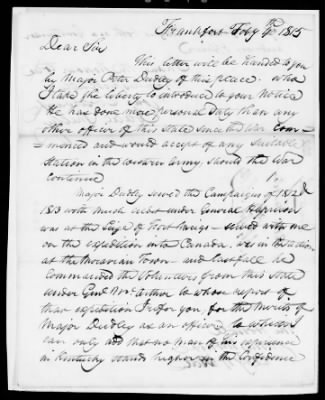
Peter Dudley


In the Calendar of the Papers of John Jordan Crittenden:

1837 Dudley, P.[eter] re War of 1812

Source
...for indemnity for loss in cost of equipping the Regiment of Volunteer mounted gunners of Kentucky in service of the U.S. [in war of 1812].

Another letter [written by Isaac Shelby to James Monroe] from the Peter Dudley file at Fold3:


Tuesday, March 4, 2014

Battle Of Longwoods


From Wikipedia:

The Battle of Longwoods took place during the Anglo-American War of 1812. On 4 March 1814, a mounted American raiding party defeated an attempt by British regulars, volunteers from the Canadian militia and Native Americans to intercept them near Wardsville, in present-day Southwest Middlesex, Ontario.


Source

Monday, March 3, 2014

A Change Of Scenery


From The Founders of Anne Arundel and Howard Counties, Maryland...:


Lindsey Warfield [of Maryland] entered the war of 1812, and was stationed in the Genesee Valley.  He was engaged in the battle of Lundy's Lane. Pleased with the country of that valley, he returned after the war, and settled there [Yates County, New York]. He married Elizabeth L'amoreaux.

The soldier in the 1860 census:


Was there also a Michigan connection?

PENSIONERS OF TERRITORIAL MICHIGAN 

T. 6, S. of R. 10 W. Nottawa Twp. St. Joseph Co., Michigan. The land on which the trading post was located was entered from the Government by Lindsey Warfield of Gates [Yates] Co., N. Y., June 7, 1831; Warfield deeded one acre to School District No. 1 of Nottawa. The trading post was located between the school house and the corner of the Section on the old trail, afterwards a branch of the old Territorial road."


Sunday, March 2, 2014

Alarm Post At Black Rock


Black Rock was considered as the Alarm Post, for the American army... . [Source]


Source

The Black Rock portion of the map above:


Saturday, March 1, 2014

Political Dynamite


Source

From the Star-Tribune (May 2012):

"Two hundred years ago (2012), President Madison dealt with what in our time might be dubbed 'Henry-gate.' He and James Monroe, were being accused of manipulating intelligence, as rumors of war roiled Washington."'

"With Secretary of State James Monroe, Madison learned that the Comte de Crillon and Capt. Henry possessed diplomatic dynamite."

Did he [Henry] start the war blog post as well as a post entitled Henry's Secret Pre-War Mission.

Excerpted from this site:

Count Edward de Crillon*...had met John Henry in London society. When he appeared on the Boston packet, a friendship arose between these two men so hardly treated by fortune. ...Crillon gave himself much concern in the affair, urging Henry to have no more to do with an ungrateful [British] government, but to obtain from the United States the money that England refused. The count offered to act as negotiator...to approach the Secretary of State.

*de Crillon was a fraud

A description of the imposter from this source:

"Crillon had hardly left the shores of America when a dispatch arrived in Washington... . To the chagrin of Madison and Monroe he [Barlow] announced that there was no Duc de Crillon... . Count Edouard de Crillon was an impostor. The only thing about him that was real was the $50,000 of government money he had in his pocket!"