Friday, March 14, 2014

Loyalty And Treason In Upper Canada


The War of 1812: Loyalty and Treason In Upper Canada is an article on the Ontario [Canada] Ministry of Government Services website.

"Wartime in Upper Canada, which had a mixed population of loyalists and more recent American immigrants, posed problems for individuals and the government."

"There is no doubt that some residents actively helped American forces when parts of Upper Canada were under military occupation."

"On March 14, 1814, the Legislature of Upper Canada passed three acts as emergency measures. The first limited the right to habeas corpus applications for those accused of treason; the second provided for trials for treason and related charges in districts outside the area where the alleged offences occurred; the third act, and the one that had the greatest impact, was the Alien Act which made it an offence for anyone to have left the province after July 1812 for the United States."

Thursday, March 13, 2014

An Assist From Lafitte's Pirates


Several attempts were made to break up the band [of Lafitte's pirates] and the U.S. Grand Jury more than once indicted Lafitte, but the government could never arrest him. At the very time when a Federal force was being equipped to descend upon the settlement of Barataria, the pirates were able to do the United States a great service, which saved New Orleans from capture by the British, and won for Lafitte the title of the "pirate patriot." When the British were arranging their expedition against the city, they prepared to advance on it by way of Barataria, and sent a man-of-war to the island to make terms with Lafitte and secure the co- operation of the pirates in capturing New Orleans, offering as a bribe a large sum of money and to Lafitte personally a commission as captain in the British navy.

Lafitte affected acquiescence in these proposals, but at the same time warned Governor Claiborne of the approach of the British, and thus enabled the United States to take steps for the defence of the city and to send General Jackson there.

Notwithstanding Lafitte's services, an expedition was fitted up against the pirates and the settlement captured. The Baratarians were ironed and committed to the Calaboose at New Orleans, and their spoils, consisting of an immense amount of valuable goods, money, etc., seized and conveyed to the city.

At the battle of New Orleans, General Jackson being short of gunners, appointed several of Lafitte's men to the artillery, where they did good service. [Source]


Wednesday, March 12, 2014

Fort Collier


The War of 1812 helped foster the resolution of the boundary between the United States and Canada.  Fort Collier (on Drummond Island) was constructed after the War of 1812 in the mistaken belief that Drummond Island would remain British and St. Joseph would be ceded to the United States.  Many years passed before this issue was resolved and as a result Fort Collier (referred to as Fort Drummond) (1815-1828) was the last British fort in the United States of America. [Source]


Source
Fort Drummond was also known as Fort Collier or Fort Colyer.


Source


Source


Tuesday, March 11, 2014

Captain A. McDonald And A Court Martial


British Military and Naval Records (RG 8, C Series) - INDEX ONLY
Microform: c-11837


President of Regt'l Court-Martial held at Fredericton on 11th March 1813, by order of Major Bliss for trial of Andrew Steadholm and Michael Guriet (Gurier)

Monday, March 10, 2014

Captain McClellan's Military Career


British Military and Naval Records (RG 8, C Series) - INDEX ONLY
Microform: c-11837

Source

McClellan, Martin
Capt.  1st Regt.
Lincoln Militia

President at Court-Martial held for trial of James Cudney, private, Capt. George Bell's Co., 1st Lincoln Militia.
Niagara
3-11-1812

Captain McClellan met his demise:

Source

Captain McClellan's wallet is now a museum artifact at the Niagara Historical Society Museum:


Narrative: McClellan, Martin. "...From "100 Years, 100 Artefacts" compiled by Clark Bernat It was May 26th, 1813; the wife of Captain Martin McClellan...left the family farm on John Street and found safety three miles away."  "He told his wife that he would never see her or their children again."

The Museum also holds a letter regarding the guardianship of the McClellan children.


Sunday, March 9, 2014

Abram R. Woolley


From A dictionary of all officers...:


First Commandant at the Allegheny Arsenal:

Source

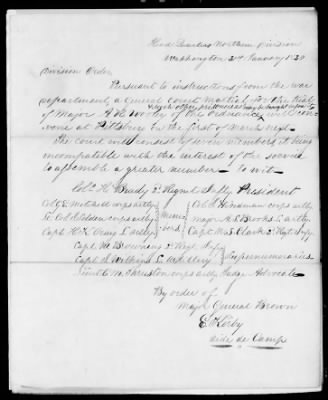
1820 Court Martial:

Source
 
An account of a court martial of Lt. Col. A. R. Woolley at Jefferson Barracks, Missouri.  He was dismissed for caning a soldier.


Saturday, March 8, 2014

The Ryersons


Life and times of Major-General Sir Isaac Brock, K. B.:


On the 6th August, Brock left York for Burlington Bay on his way to Detroit to meet the enemy, accompanied by the York Volunteers... not then knowing that the grand army had decamped.  Brock had depended on picking up the militia by the way and appointed a rendezvous at Long Point in the county of Norfolk. Not far from this place was the residence of Colonel Ryerson of the Norfolk militia.

Among the band of the United Empire Loyalists who took part in the war of 1812, there is no name more deserving of remembrance than that of George Ryerson (some time after the war the Rev. George Ryerson)....... .  The reverend gentleman and soldier was of the loyal family of Ryersons, of New Jersey, who performed eminent service to the British cause during the struggle of the American colonies for independence .  George was the son of Joseph Ryerson, and brother of the Rev. Egerton Ryerson...  .