Thursday, February 7, 2013
Battle Of The Ice Mound
We had, in the winter of 1813-14*, a little affair on the Eastern Shore which went by the name of " The Battle of the Ice Mound." *February 7, 1815, was the date of the Battle Of The Ice Mound found on the historical marker. It is known as one of the last battles of the War of 1812.
A small schooner of ours taken by the British and manned by a few men under the command of a lieutenant and a midshipman, got frozen up in the ice near Kent Island. A number of the country militia [Colonel Jones] got out to this mound, and using it as a point of attack, protected from the enemy's fire, made a brisk assault from it upon the schooner, which was soon obliged to strike her colors.
The lieutenant and midshipman, with their party, were made prisoners, and were sent to Baltimore, where the two officers spent the winter,—quite distinguished objects in society,—and, I doubt not, much gratified at the exchange of their wintry guard on the bay for the comforts of a pleasant captivity. [All of the above from The Life of John Pendleton Kennedy]
From the Wednesday, February 22, 1815, edition of the American and Commercial Daily Advertiser (GenealogyBank.com):


Wednesday, February 6, 2013
Remains
200 Years Later, Remains Of Kentucky Soldiers Killed In War Of 1812 May Be Coming Home was an online article at "Lex 18" news (Lexington, Kentucky).
"Imagine waiting 200 years to be buried in your homeland. A discovery in an Ontario, Canada park means two Kentucky soldiers who fought in the War of 1812 could finally be coming home...".
Tuesday, February 5, 2013
Surrendered Sword
| Source |
Monday, February 4, 2013
Archaeology In Caulk's Field
From Yahoo News, Battlefield from War of 1812 Uncovered Intact Beneath Maryland Cornfield:
Yahoo News was linked to the L.A. Times that provided this:
""This is easily the best-preserved 1812 battlefield in the Mid-Atlantic, thanks to the excellent stewardship of the owners, the Tulip Forest Farming Corp., who understood its importance and protected it," said Bill Pencek, the commission's executive director.""
History is still very much with us today as evidenced by a new and fascinating find - a battlefield from the War of 1812 when American were still very much engaged with fighting the British. And this battlefield is virtually unscathed.
Yahoo News was linked to the L.A. Times that provided this:
""This is easily the best-preserved 1812 battlefield in the Mid-Atlantic, thanks to the excellent stewardship of the owners, the Tulip Forest Farming Corp., who understood its importance and protected it," said Bill Pencek, the commission's executive director.""
Sunday, February 3, 2013
A Canadian Company Of Blacks
Captain Runchey's Company of the First Lincoln Regiment:
 |
| Source |
Engagements: Queenston, 13th, Oct., 12. and Fort George, 27th May, 13.
Captain Robert Runchey, Sr.
James Robertson
Lieutenant George Runchey
From Wikipedia: On 3 March 1813, the unit was converted into the Corps of Provincial Artificers under the command of Lt. James Robertson, a black settler formerly of Detroit who had been a member of Butlers Rangers in the Revolutionary War as well as the Corps of Provincial Artificers before joining the Coloured Corps sometime before the Battle of Queenston Heights. While this might have appeared to be a backward step, the scarcity of the sundry skills required of Artificers meant that they were paid two to four times as much as they would have been as private soldiers.
Working under the direction of a white officer, Captain Robert Runchey Sr., thousands of volunteers fought for the British during the War of 1812. Niagara Blacks in Runchey’s unit included Pierpoint, brothers James and Humphrey Waters, John Delay, John Jackson, Robert Jupiter, John Saunders, and George Martin.
The blog, North End Journal, has a post about Runchey's men.
Saturday, February 2, 2013
From Captain Rhea At Fort Wayne
This letter was written pre-war; however Captain Rhea was the commandant at Fort Wayne during the early war years.
Dated Fort Wayne, February 2, 1811, to Major Abymael Nicholl, Inspector of the U.S. Army:
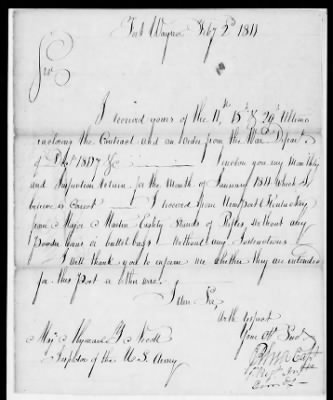
I received yours of the 11th, 15th & 29...enclosing the contract and an order from the War Dept of Dec 1807...my monthly and Inspection return for the month of January 1811 which I believe is correct...I received from Newport, Kentucky*, from Major Martin Eighty Stands of Rifles without any powder ___ or bullet bags...without any Instructions.
I will thank you to inform me whether they are intended for this post or other wise.
Rhea
Capt.
1st Reg Inf
Comm of---
In 1803, General James Taylor, as agent for his father and other owners, sold to the government the ground upon which the barracks are situated.
In 1811 and '12, Newport barracks was the chief depot for military stores. From here were sent supplies of ammunition, arms and provisions, to General Harrison at Vincennes.
Friday, February 1, 2013
John Armstrong, Secretary Of War
| Source Of Portrait And Text: The Military Heroes Of The War of 1812 |
Armstrong was not present in any battle during the war of 1812 [he was Secretary of War and "projector of the campaign of 1813"]... . It can scarcely be said that he was a very able or a very fortunate leader. None of his projects were crowned with success. Though he removed his department from Washington to the northern frontier in order to be nearer the scene of operations, he gained nothing from the step but the envy of his Generals.
Yet it would be improper to speak of Armstrong in a tone of unqualified censure. He experienced many things to exasperate him... . The failure of the campaign of 1813 was far from being entirely his fault. In fact the very errors which led to that failure, he had early warned the commanding Generals against and the removal of the department to the northern frontier was projected in hopes to prevent by his presence unnecessary delays.
Subscribe to:
Posts (Atom)